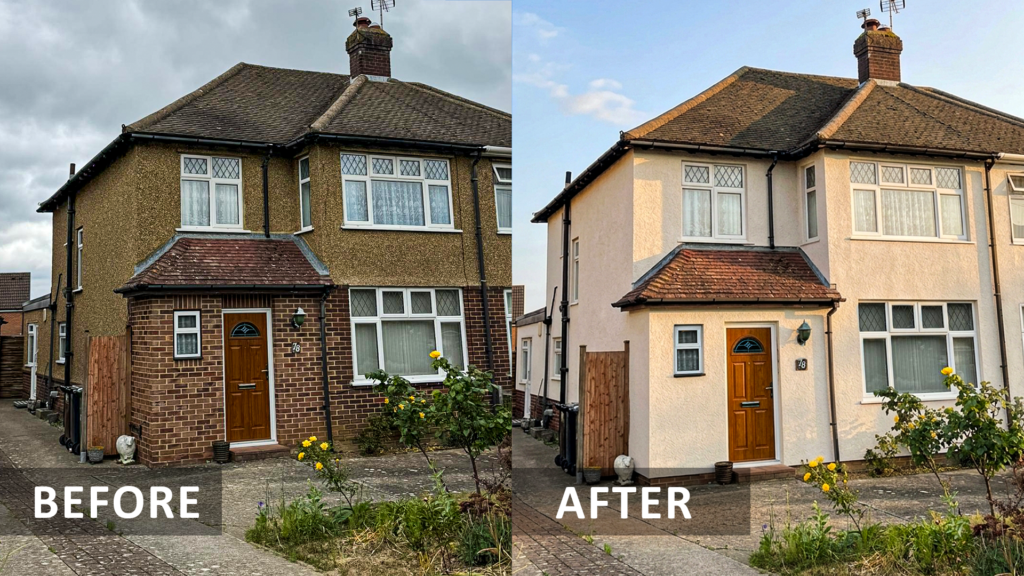
If you are replacing external render and have come across thermal render for the first time, this guide covers everything you need to know — what it is, how it performs, and whether it is worth choosing for your property.
Standard external render — sand and cement, monocouche, acrylic — has two jobs: weather protection and decoration. It does both well. What it does not do is provide any meaningful thermal insulation. The aggregate in standard render is sand, which has a thermal conductivity of approximately 0.5–1.5 W/mK depending on type. Heat passes through it freely.This is the same for all the existing render systems on the UK market.
ThermoSilicone uses expanded perlite instead of sand as its primary aggregate. Perlite has a thermal conductivity of 0.058 W/mK — a fraction of sand’s conductivity. The difference is measurable: ThermoSilicone at 20mm base coat depth increases the R-Value of a single-skin masonry wall by 310% (from 0.18 to 0.738 m2K/W). Standard render makes no measurable improvement.
No. As Proofshield’s official South East installation partner, we price ThermoSilicone at the same level as a conventional re-render. The product costs more to manufacture, but we absorb that difference. If you are paying for a re-render anyway, there is no reason not to have one that insulates.
ThermoSilicone delivers the greatest thermal improvement on solid-wall properties — Victorian and Edwardian terraces, interwar semis, stone-built homes — where walls are the primary source of heat loss. On modern cavity-wall properties with existing insulation, the marginal benefit is smaller, though the breathability and crack resistance of the system still represent an improvement over standard options and the increased thermal performance still adds genuine insulation value.