BLOG ARTICLE 1

How to Reduce Heat Loss Through Solid Walls

If your home was built before the 1920s, it almost certainly has solid walls — meaning no cavity between the inner and outer leaf of brick or stone. These walls have no insulation layer, and they account for a disproportionate share of your home’s heat loss. This article explains why, and what you can do about it.

Why Solid Walls Lose So Much Heat

A cavity wall — the standard construction from the 1920s onwards — consists of two layers of masonry with a gap between them. That cavity interrupts the path of heat conduction, and when filled with insulation, it provides a significant thermal barrier.

A solid wall has no cavity. Heat travels continuously from the warm interior, through the wall fabric, to the cold exterior. The rate of this heat transfer depends on the thermal resistance (R-Value) of the wall construction. An uninsulated single-skin solid masonry wall has an R-Value of around 0.18 m2K/W — very low. Heat passes through it with almost no resistance.


The Options for Insulating Solid Walls

There are three main approaches to improving the thermal performance of solid walls:

  • External Wall Insulation (EWI) — rigid insulation boards fixed to the external wall face before rendering. High insulation values, but expensive, disruptive and changes the external appearance of the property. Can cause damp and mould problems if ventilationis not addressed at the same time.
  • Internal Wall Insulation — insulation boards or insulating plaster applied to the internal face of external walls. No external works required, but some loss of internal floor area.
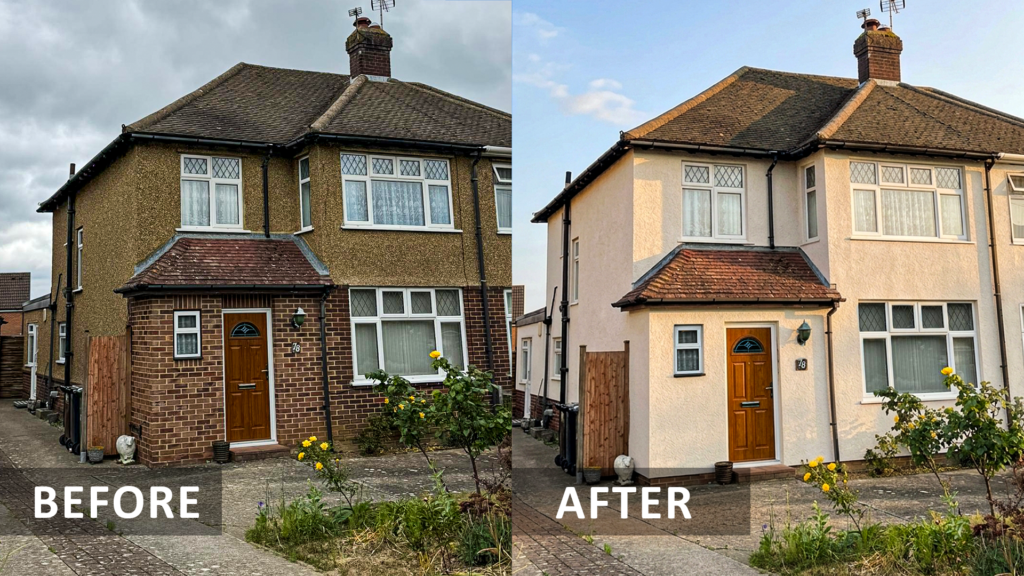
  • ThermoSilicone insulating render — applied externallyin an uninterrupted layer at approx20mm-25mm. Lower insulation values than EWI board systems but at a fraction of the cost and disruption.

What ThermoSilicone Delivers

At the standard 20mm ProofTherm base coat depth, ThermoSilicone increases the R-Value (Thermal Resistance) of a single-skin masonry wall from 0.18 to 0.738 m2K/W — a 310% improvement. At 30mm, the improvement is 406%.


For many solid-wall properties, this represents the most cost-effective available improvement in wall thermal performance. It is applied by our Proofshield-trained team at the same price as a standard re-render, with no premium for the insulating performance.

Internal Option: ProofTherm Plaster

Where external render replacement is not appropriate — for example, where external appearance is constrained by planning or the property is in a terrace where only the rear elevation can be treated — ProofTherm internal plaster provides the same insulating base coat applied to the internal wall face. No external works, no scaffolding, and the same 15-year warranty.

Leave a Reply

Your email address will not be published. Required fields are marked *

Categories