

Thermal Plastering is the South East’s official installation partner of Proofshield — bringing you ThermoSilicone insulating render and ProofTherm insulating plaster at exactly the same price as a conventional system. Highly breathable. Warmer in winter. Cooler in summer. Guaranteed for 15 years.
Heat loss through walls occurs primarily because of poor thermal resistance. Standard external renders — sand and cement, monocouche, acrylic — provide weather protection and a decorative finish, but they offer no meaningful resistance to heat conduction. Heat generated inside your home travels freely through the wall to the outside. You pay to heat your home, and the heat leaves through your walls.
For properties with solid wall construction — typically those built before the 1920s — this heat loss is particularly significant. There is no cavity, no insulation layer, and no interruption to the path of heat transfer. The walls can be the single largest source of heat loss in the building.
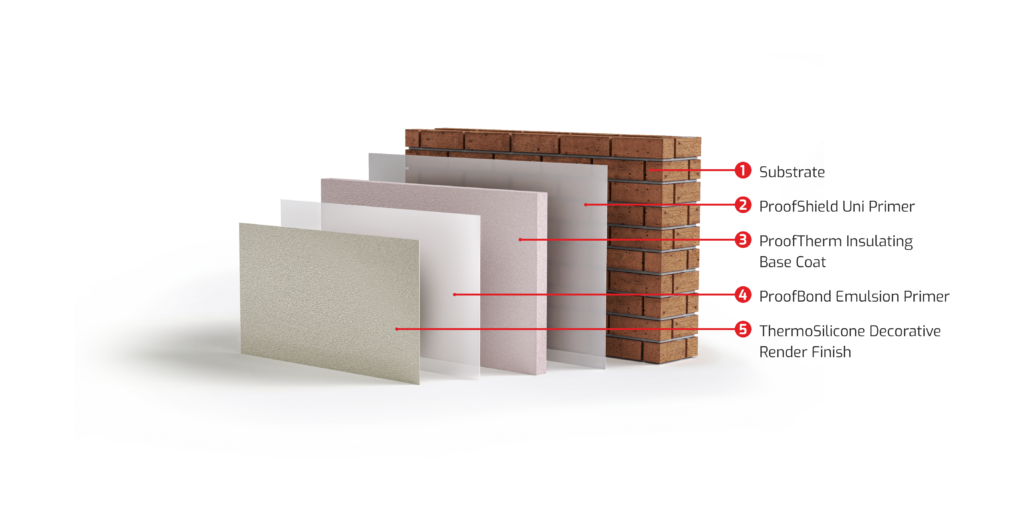
The ThermoSilicone system uses two mechanisms to reduce heat transfer through external walls:
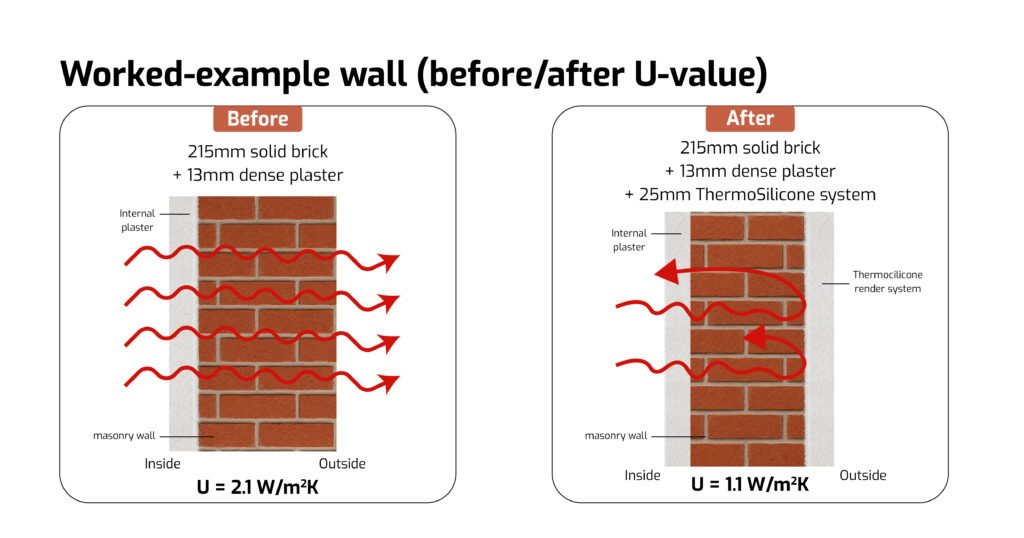

The base coat uses expanded perlite — a volcanic mineral with a honeycomb microstructure of air bubbles — as its primary aggregate. Perlite has a thermal conductivity of 0.058 W/mK, making it an extremely effective thermal barrier. Applied at a depth of 20–25mm, it creates an uninterrupted insulating layer across the entire external wall face.
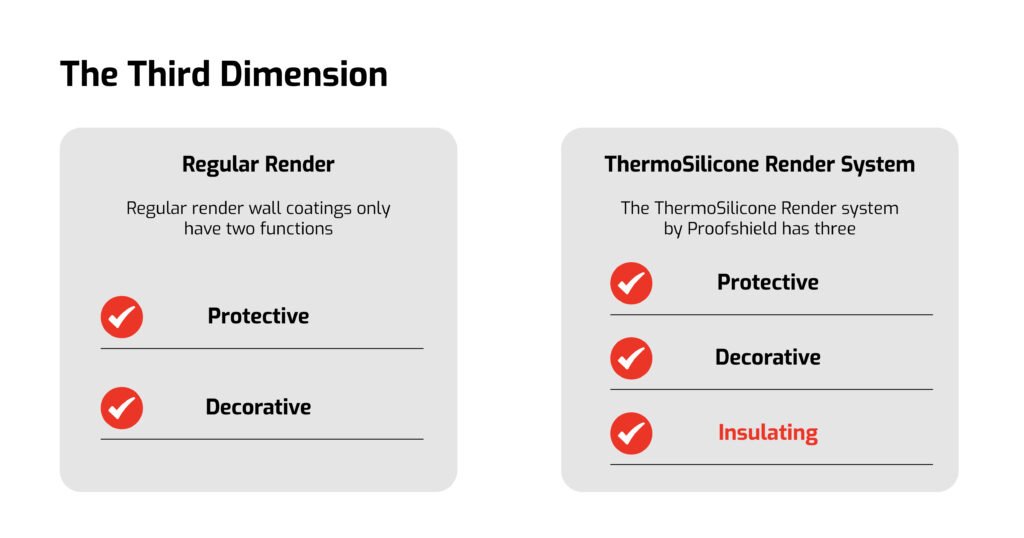

The silicone decorative finish coat contains ceramic microspheres which further disrupt the path of heat transfer through the wall. It is also weather and crack resistant, vapour permeable, and available in a wide range of colours — see ‘A Render System That Lets Your Walls Breathe’ below for why this matters.
The table below shows R-Value (thermal resistance) improvements for a single-skin masonry wall at different ProofTherm base coat thicknesses. The higher the R-Value, the better the insulation.
At the standard 20mm application depth, ThermoSilicone increases the thermal resistance of a single-skin masonry wall by 310%. At 30mm, the improvement is 406%
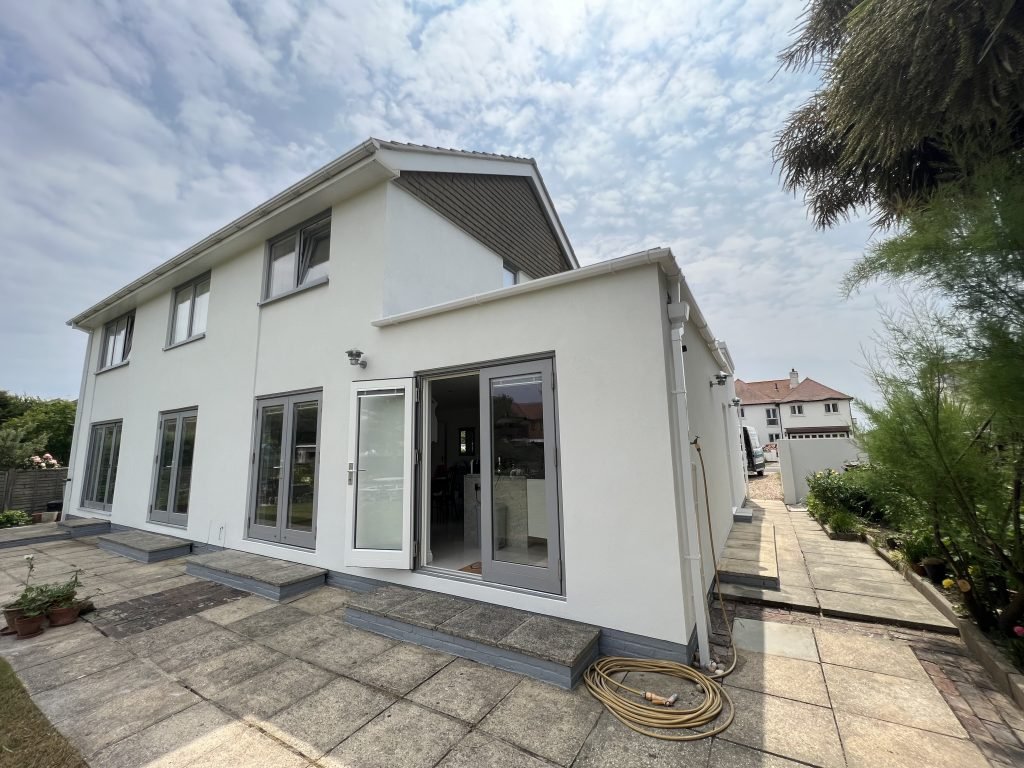
Increasing the thermal resistance of your external walls has two direct effects on your home’s comfort and running costs:
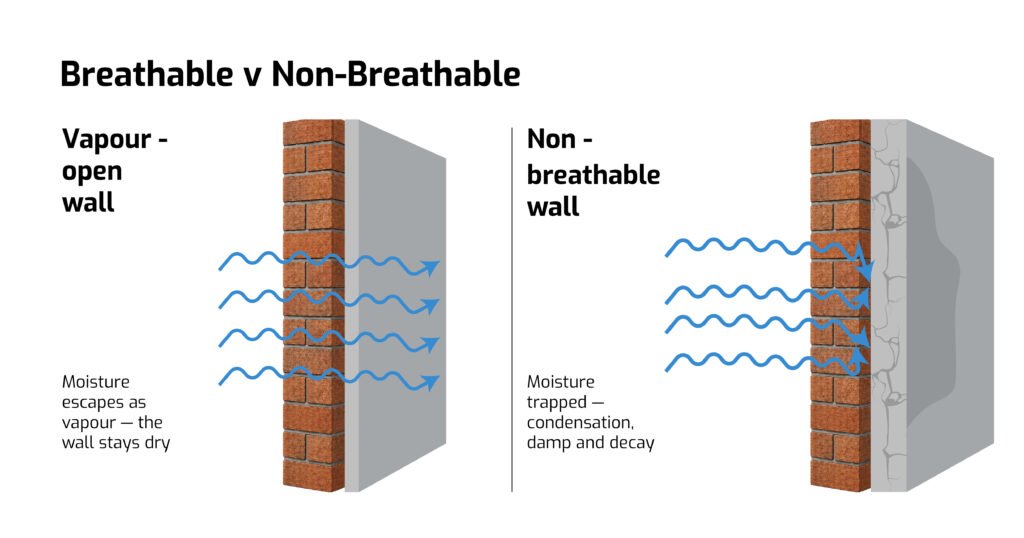
Many ways of improving a wall’s thermal performance make trapped moisture worse, not better. Solid-wall properties move water vapour from the warm interior outward through the wall fabric as a matter of course. Seal that pathway with an impermeable render or coating, and the moisture has nowhere to go — it accumulates within the wall structure, where it can saturate the brickwork, undermine the bond of the render itself, and recreate the exact damp and mould conditions a thermal upgrade is meant to solve.
ThermoSilicone is built to avoid this. Both the ProofTherm insulating base coat and the silicone finish coat are vapour permeable, so moisture vapour continues to pass outward through the wall and evaporate at the surface — just as it would in an untreated wall — only now through a layer that also resists heat loss and sheds driving rain. In practice, this means walls already holding residual or rising damp are able to dry out over time once ThermoSilicone is installed, rather than having that moisture sealed in behind the render.
This combination — insulating without sealing — is what distinguishes a vapour-permeable system like ThermoSilicone from impermeable render finishes, such as acrylic render, or other coatings where any thermal benefit can be offset by the moisture problems the coating itself introduces
Cavity wall insulation fills the gap between the inner and outer leaf of a cavity wall. It is not an option for solid-wall properties — which have no cavity to fill. ThermoSilicone is specifically designed for solid-wall construction, applying the insulating layer to the external face of the wall where it creates an uninterrupted thermal barrier.
External wall insulation (EWI) board systems apply rigid insulation boards to the external wall before rendering. They provide higher insulation values than ThermoSilicone but at significantly higher cost, greater disruption, and with more significant changes to the property’s external appearance. Critically, they create a sealed layer that cannot breathe and in older buildings this can often lead to problems. ThermoSilicone is applied at between 20-25mm in a continuous layer which means much less disruption to external features.
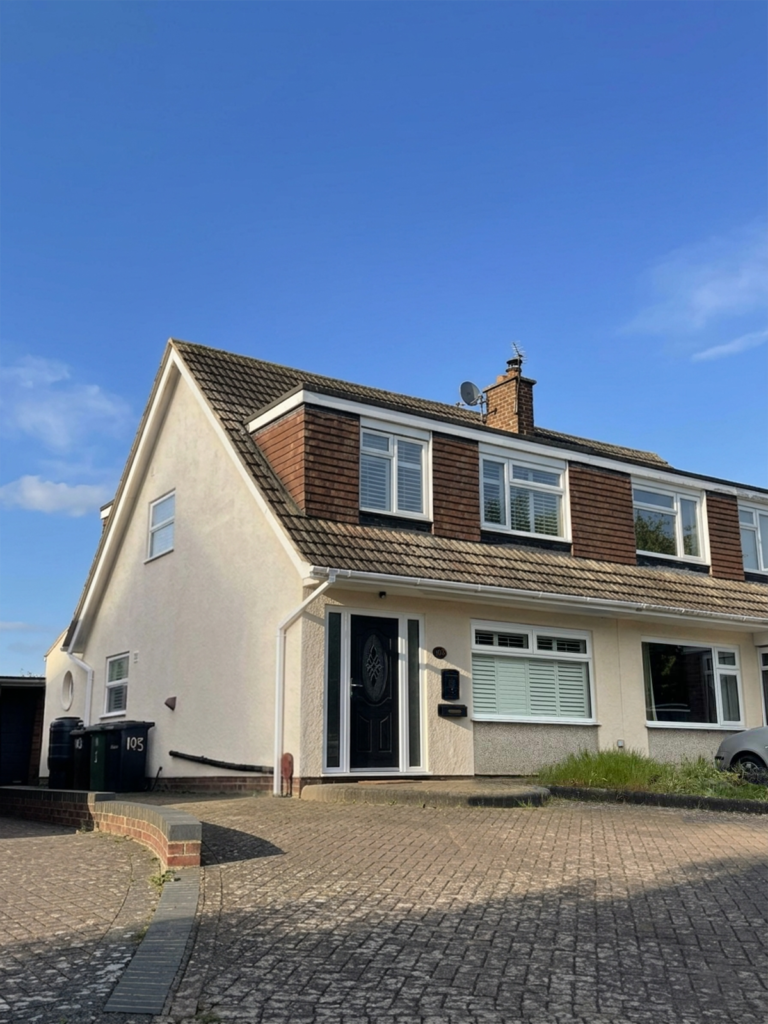
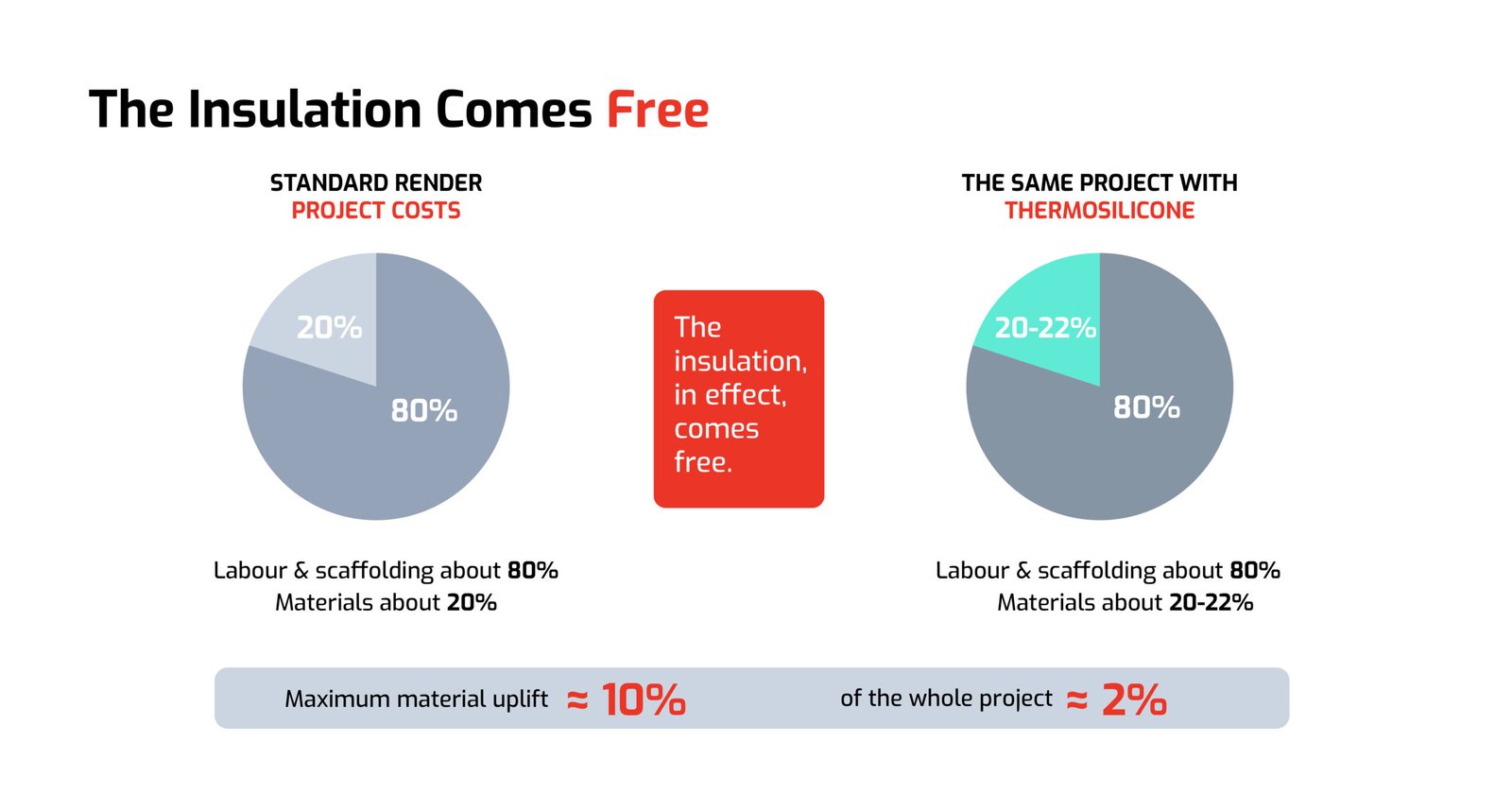
No. ThermoSilicone is priced at the same level as a conventional external re-render. The application process and timescale are the same. There is no premium for the thermal performance.
The silicone finish coat is available in a popular range of pastel colours. We can show you the options when we survey.
Where existing render is in poor condition — debonding, cracked, or failing — it is removed before ThermoSilicone is applied. Applying over a failing substrate would compromise both adhesion and thermal performance, and would void the warranty. We assess the substrate condition at the free survey.
A typical semi-detached property takes two to four days. Larger properties or those requiring more extensive preparation may take longer. We confirm the exact programme at survey stage.
The ThermoSilicone finish coat provides a smooth, textured decorative finish comparable in appearance to conventional silicone or monocouche render. The overall wall thickness increase is tminimal — there is no visible change to window and door reveals.
Spray-applied cork render products are typically applied at around 2–6mm thick, with published thermal conductivity figures across the market ranging from roughly 0.035 to 0.076 W/mK depending on the product. Using the standard resistance calculation — thickness divided by conductivity — this typically adds somewhere in the region of 0.05 to 0.15 m²K/W of thermal resistance to a wall. The ProofTherm base coat within ThermoSilicone is applied far thicker, at 20–25mm, with a thermal conductivity of 0.058 W/mK, adding roughly 0.35 to 0.43 m²K/W of resistance by the same calculation — several times the contribution of a thin cork coating. Cork render has genuine strengths, particularly for acoustic performance and refreshing an existing render without removing it, but if thermal performance is the priority, we’d encourage homeowners to ask for the published conductivity and application depth of the specific cork product quoted, run the same calculation, and weigh the result against the price per m² before deciding.
Book a free, no-obligation survey. We will visit your property, assess your walls, and tell you exactly which Proofshield system is right for you — and what it will cost. No pressure, no hard sell.